

Course Description
Modern video games
employ a variety of sophisticated algorithms to produce groundbreaking 3D
rendering pushing the visual boundaries and interactive experience of rich
environments. This course brings state-of-the-art and production-proven
rendering techniques for fast, interactive rendering of complex and engaging
virtual worlds of video games.
This year the
course includes speakers from the makers of several innovative games and game engines,
such as Activision, Electronic Arts, Sony, IO Interactive, Roblox, Meta, and
more. The presenters will cover a wide range of topics, from innovations in
real-time ray tracing and path tracing techniques for multiplatform AAA games,
to demystification of development of machine-learning based algorithms for
upscaling, adaptive tessellation improvements on GPU, real-time volumetric
effects, as well as efficient approaches for rendering kit-based UGC
representations in dynamic worlds, and more.
This is the course
to attend if you are in the game development industry or want to learn the
latest and greatest techniques in the real-time rendering domain!
Previous years’ Advances course
slides: go here
Syllabus
Advances in Real-Time Rendering in
Games: Part I
Tuesday, 21 July 2026 9:00am - 12:15pm
PDT
Location: Petree D
Advances in Real-Time Rendering in Games - Game
and Rendering Trends, a 2026 Take.
Natalya Tatarchuk (Activision)
Speeding up Path Tracing
via ORCA (Online Radiance Cache Acceleration)
Jon Greenberg (EA SEED)
Upgrading PSSR on PlayStation5 Pro
Daniel Craig (Sony Interactive
Entertainment)
Variable Rate Ray Tracing in Call
of Duty: Modern Warfare 4
Michał Olejnik (Activision Infinity
Ward)
Closing Notes for Part I
Natalya Tatarchuk (Activision)
Advances in Real-Time Rendering in
Games: Part II
Tuesday, 21 July 2026 2:00pm - 5:15pm
PDT
Location: Petree D
Welcome and Introduction to Part II
Natalya Tatarchuk (Activision)
Smolder — Real-Time Volumetric
Effect Rendering in Glacier and 007 First Light
Alexander Mueller (IO Interactive)
SLIM: Scaling User-Generated 3D Worlds
on Roblox
Sergey Makeev (Roblox)
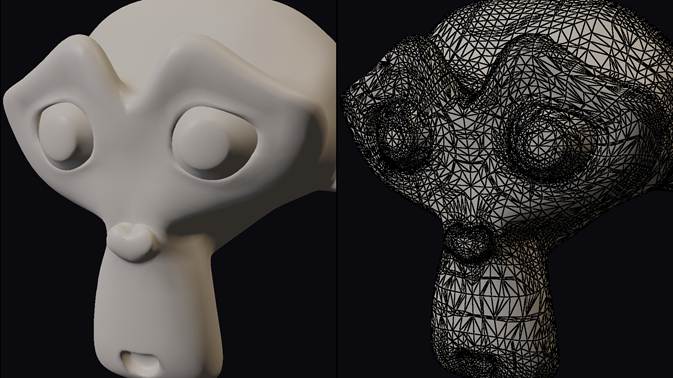
Adaptive Tessellation and
Subdivision
John Hable (Meta)
Closing Notes for Advances in Real-Time Rendering
in Games
Natalya Tatarchuk (Activision)
Prerequisites
Working
knowledge of modern real-time graphics APIs like DirectX or Vulkan or Metal and
a solid basis in commonly used graphics algorithms. Familiarity with the
concepts of programmable shading and shading languages. Familiarity with
shipping gaming consoles hardware and software capabilities is a plus but not
required.
Intended
Audience
Technical
practitioners and developers of graphics engines for visualization, games, or
effects rendering who are interested in interactive rendering.
Course
Organizer

Natalya
Tatarchuk is a
graphics engineer and rendering enthusiast at heart, currently serving as Chief
Technology Officer at Activision Publishing. In this role, she leads the
technology strategy and execution across major Activision franchises -
including Call of Duty - driving innovation at the intersection of
cutting-edge tech and game development at scale.
Previously,
Natalya was Distinguished Technical Fellow and Chief Architect, VP of
Wētā Tools at Unity, where she advanced state-of-the-art rendering,
graphics performance, and character creation tools for film and games. Before
that, as VP of Graphics for the Unity Editor and Engine, she led Unity’s
graphics initiatives across the real-time rendering stack.
Natalya’s
roots in AAA game development include nearly a decade at Bungie, where she
contributed to the groundbreaking visuals and engine architecture for Destiny
and the Halo franchise—including Halo 3: ODST and Halo: Reach.
She led the graphics group and contributed to engine development, the visual
innovation and cross-platform rendering of Destiny franchise.
Earlier
in her career, she worked at AMD’s Graphics Products Group, where she pushed the
boundaries of parallel computing and explored advanced real-time graphics
techniques, graphics hardware design, and next-generation API development.
One
of Natalya’s passions is fostering knowledge-sharing in the real-time graphics
community, as she strongly believes that advancing the state of the art is
always more powerful when done together. For over two decades, she has
organized and curated some of the industry's most influential technical forums,
including the Advances in Real-Time
Rendering, Open Problems in Real-Time
Rendering, and
Rendering Engine Architecture courses. Most recently, she has co-organized Rendering Engine Architecture
conferences with
a few gaming industry colleagues.
Talks
SPEEDING UP PATH TRACING VIA ORCA (ONLINE RADIANCE CACHE ACCELERATION)
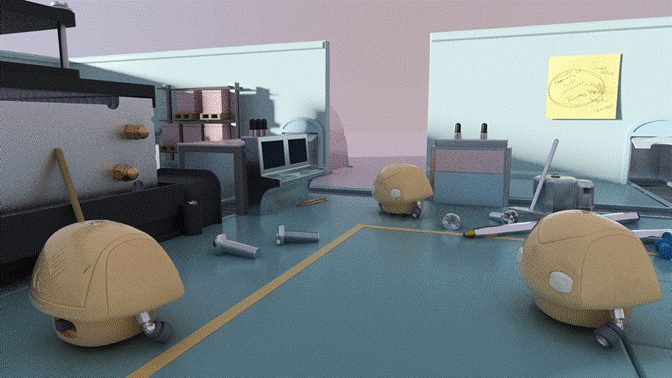
Abstract:
Path tracing is unfortunately quite slow on modern hardware and quite
challenging to implement in real time game rendering, as a result. We present a straightforward approach to
dramatically speed up path tracing via a custom radiance cache designed
specifically for real-time rendering use.
This technique, ORCA, does not depend on temporal history. All data structures are instantaneous and
don't need to survive the frame, making it ideal for fully dynamic scenes. We'll discuss both how it's implemented and
how one can hook it into an existing real-time path tracer with minimal
changes.
Speaker Bio:

Jon
Greenberg has
been working in the game industry for over 26 years, spanning 4 generations of
console gaming hardware. He cut his
teeth at Midway Games Chicago, then continued on to NetherRealm, working on the
high-performance demands of fighting games.
Running the rendering team on the Mortal Kombat franchise led him
to spending... perhaps too much time thinking about evolving violent gore tech
in games, an entirely different way of interpreting the term "cutting edge
graphics". Following work on "Injustice
2" and "Mortal Kombat 11" he left NetherRealm to join
the SEED team at Electronic Arts where he's busy researching new rendering
techniques.
Materials (Updated 8/3/2026): PPTX (436 MB)
UPGRADING PSSR ON
PLAYSTATION5 PRO
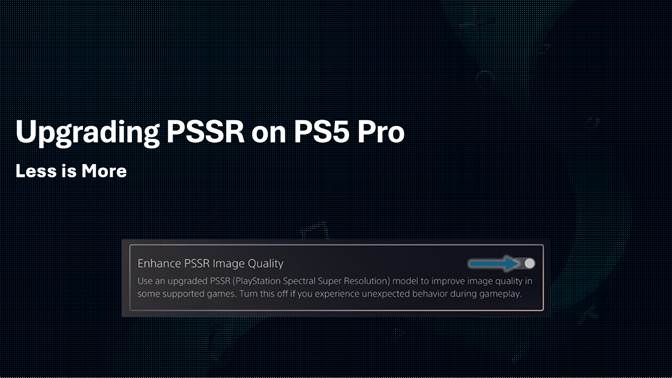
Abstract:
Machine-learning-based upscaling has become a core technology in real-time
rendering, yet how these systems work is often opaque. This talk covers
PlayStation Spectral Super Resolution, or PSSR, and specifically the recent
redesign of Upgraded PSSR on PlayStation 5 Pro. The launch version of PSSR
framed almost the entire reconstruction pipeline as a single Color-Predicting
Network. This gave the model a wide surface area for optimization, but it also implicitly
asked the model to solve a number of disparate problems that already had
efficient closed-form solutions. The talk will show how that generality became
a cost, and how the upgrade walked much of it back: restoring explicit
closed-form solutions where possible and focusing the model on the pattern
recognition it is best suited for. The result improved visual quality and
temporal stability while reducing runtime, memory, and training cost by giving
the model less to do, not more.
Speaker Bio:

Daniel Craig is a Principal Software Engineer at SIE, where he
focuses on real-time rendering. Most recently, he was the lead researcher for
Sony’s Upgraded PSSR ML upscaling library. He began his career at Adaptec,
working on SCSI RAID controllers, before moving into the games industry about
22 years ago. His background in systems engineering shifted toward rendering
around the launch of the PS3, and he has worked in rendering ever since.
Outside of work, Daniel is an avid mountain climber — a passion that grew from
the realization that climbing is, at its core, practical real-time
optimization.
Materials (Updated 8/13/2026): PPTX (54 MB),
PDF with
speaker notes (5.3 MB)
VARIABLE RATE RAY
TRACING IN CALL OF DUTY: MODERN WARFARE 4
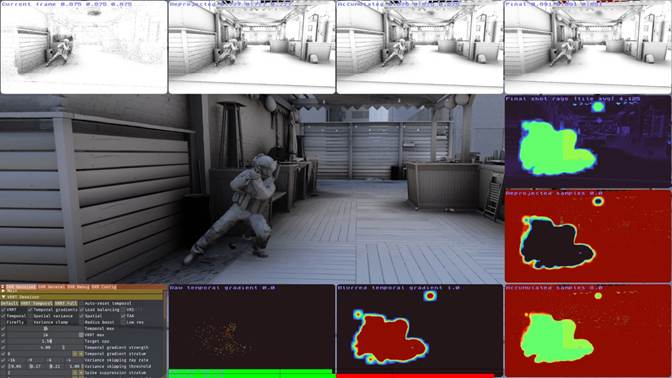
Abstract:
Real-time ray tracing in a fast-paced multiplayer shooter presents a unique
challenge: image quality must remain stable under rapid camera motion and
dynamic object movement - while frame time budgets remain unforgiving. In Call
of Duty: Modern Warfare 4, traditional fixed-rate ray tracing with
screen-space denoising proved insufficient: disocclusion artifacts and temporal
lag are far too distracting during competitive play.
We present a production-proven
Variable Rate Ray Tracing (VRRT) system designed to deliver consistent quality
without sacrificing deterministic performance.
Our approach
dynamically allocates ray budgets per pixel, supporting both sub-1
sample-per-pixel tracing (spatial undersampling with temporal reconstruction)
and selective supersampling (>1 spp) where stability is critical. We
leverage a temporal gradient pre-pass and explicit disocclusion detection to
proactively identify unstable pixels and selectively increase sampling before
artifacts appear. On top of that, we deploy a fully GPU-driven frame-level
scheduler that redistributes rays spatially while maintaining a constant total
ray count per frame. This guarantees stable GPU cost and eliminates performance
spikes, even under heavy camera motion or large dynamic events.
Speaker Bio:

Michał Olejnik is a Senior Expert Rendering Engineer at Infinity
Ward Poland, where he leads a team focused on real-time ray tracing and path
tracing. He began his graphics career at Plastic, a demoscene-born independent
studio, working on the PlayStation 4 exclusive experimental title Bound. In
2017, he joined the newly established Infinity Ward Poland, eventually focusing
on ray tracing research and development. Since then, he has led the development
of multiple ray tracing systems across the Call of Duty franchise,
including Modern Warfare (2019) and Black Ops 7 (2025), as well
as a prototype real-time path tracer in Modern Warfare III (2023). His
current work focuses on advancing next-generation real-time ray tracing
techniques.
Materials (Updated 8/14/2026): PPTX
(387 MB), PDF
with speaker notes (12.3 MB)
SMOLDER — REAL-TIME VOLUMETRIC EFFECT RENDERING IN GLACIER AND 007
FIRST LIGHT
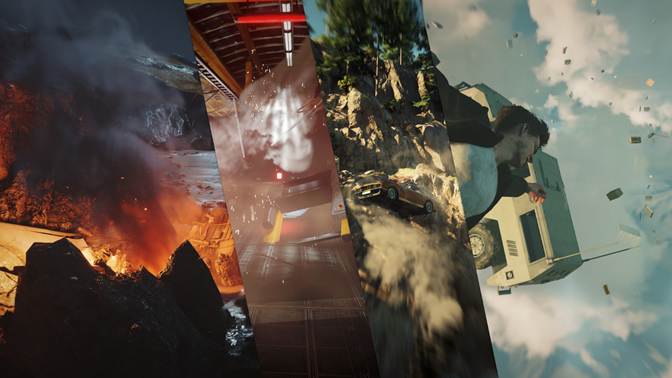
Abstract:
In recent years, volumetric rendering techniques have become more popular for
real-time rendering in video games. However, they are usually limited to
specific use cases like clouds or volumetric fog, or they require a lot of custom
setup work to achieve a believable result. With 007 First Light, we
introduced Smolder, a fully integrated, scalable, real-time volumetric
effect rendering framework, into our Glacier engine. Smolder enables us to use
volumetric effects as if they were any other type of VFX. It is fully
integrated with all lighting systems in Glacier, as well as with the various
layers in the scene — opaque, transparent, and volumetric fog. This enables our
artists to work freely with Smolder when building the environments, cinematics,
and in-game moments, and it enables us to add player-controlled volumetric
effects to Bond’s various gadgets. This presentation provides an in-depth look
at how Smolder works, as well as the path we took to get there. It evaluates
the benefits and drawbacks of the various parts of the Smolder algorithm and
concludes with a look at where Smolder can go from here.
Speaker Bio:

Alexander
Mueller is a
Senior Rendering Engineer at IO Interactive, working on the custom Glacier
engine. He specializes in lighting and performance work, with a focus on
volumetrics and global illumination. Before joining IOI, he worked as a render
programmer at Ubisoft Mainz.
Materials (Updated 8/3/2026): PPTX (265 MB), PDF with speaker notes
(30 MB)
SLIM: SCALING
USER-GENERATED 3D WORLDS ON ROBLOX
Abstract:
Roblox games are built from arbitrary user-generated content, kitbashed by
millions of creators without traditional art-direction constraints, fixed
content budgets, manually authored LODs, or predictable runtime behavior. These
games must run across a broad range of devices with vastly different compute,
memory, graphics, and network capabilities.
In this talk, we present SLIM - a cloud-based
system that automatically generates lightweight, device-adaptive runtime representations
of Roblox worlds while preserving authored appearance, behavior, and semantics.
We cover the motivation, architecture, integration, and production challenges
of building and deploying SLIM at scale across petabytes of existing
user-generated content. We discuss the tradeoffs in representation generation,
client selection, fidelity preservation, and fallback to original content when
full runtime semantics are required. We close with future directions for
device-adaptive representations and server-assisted rendering.
Speaker Bio:

Sergey
Makeev is a
veteran graphics engineer and technical leader, currently serving as a Senior
Technical Director at Roblox. With over twenty years of experience in AAA game
development and massive-scale platforms, he specializes in architecting
high-performance rendering stacks and core engine technologies. At Roblox,
Sergey architected SLIM, a platform that automatically optimizes the
performance and visual fidelity of Roblox worlds across millions of devices. He
also pioneered Roblox's Layered Clothing system, allowing multi-layered
garments to automatically conform to any avatar body type. Additionally, he
headed the "Future Is Bright" initiative, modernizing the Roblox
rendering engine and moving it to physically-based rendering and advanced
lighting.
Earlier
in his career, Sergey served as a Technical Director, building several multiplatform
engines from scratch and providing technical leadership for major titles like Skyforge,
Warface, and Armored Warfare. He is an active contributor to the
real-time graphics community and has published his technical work in both GPU
Pro 5 and GPU Zen 2.
Materials (Updated 8/13/2026): PPTX
(469 MB), PDF
with speaker notes (20 MB)
ADAPTIVE TESSELLATION AND SUBDIVISION
Abstract:
This talk addresses the problem of tessellation and subdivision using compute
shaders. We start with the tessellation pattern itself, introducing clamped
parallelogram tessellation and discussing tradeoffs with existing tessellation
patterns. We then scale this up into a full compute-based pipeline to
tessellate meshes with screen-adaptive tessellation while welding seams. And finally,
we extend this framework to Catmull-Clark subdivision with semi-sharp creases.
Speaker Bio:

John
Hable is a
rendering engineer at Meta. He has 21 years of experience working for
Electronic Arts, Naughty Dog, Unity, and Epic. Recently, he has focused on
visibility buffer rendering and scalable geometry.
Materials (Updated 8/13/2026): PPTX (40 MB),
PDF with
speaker notes (8.5 MB)
Direct
contact (note: responses may be delayed):

ceruleite.bsky.social
Mastodon @mirror2mask