


Course Description
Modern video
games employ a variety of sophisticated algorithms to produce groundbreaking 3D
rendering pushing the visual boundaries and interactive experience of rich
environments. This course brings state-of-the-art and production-proven
rendering techniques for fast, interactive rendering of complex and engaging
virtual worlds of video games.
In 2025, SIGGRAPH will celebrate the 20th anniversary of the Advances
in Real-Time Rendering in Games program - one of the most enduring and
influential research innovation forums in computer graphics. Since its
inception in 2006, the program has served as a launchpad for groundbreaking
rendering techniques that have fundamentally reshaped how artists, rendering
engineers and game developers simulate lighting, geometry, and motion in
real-time applications, especially in video games.
From the introduction of physically based shading models and temporal
antialiasing to breakthroughs in ray tracing and neural-enhanced image quality,
the Advances in Real-Time Rendering in Games course has consistently
spotlighted state-of-the-art techniques shaping the evolution of video games,
virtual productions, architectural visualization, and interactive experiences
at scale.
The 2025 program will feature speakers from leading studios and engine
teams including Activision, Ubisoft, Epic Games, id Software, MachineGames, HypeHype, and
NVIDIA. As the 20th anniversary of the course, this year will also include a
special retrospective honoring two decades of innovation, impact and shared
technical progress in the real-time graphics community.
The presenters will cover a wide range of topics, from innovations in
subsurface scattering and real-time path tracing, new methods for performant
order-independent transparency, practical ray tracing for large-scale dynamic
open worlds, efficient multi-platform strand-based hair and fur rendering
methods, and multiple real-time stochastic direct lighting approaches for many
lights rendering, targeted from high-end to low-end mobile GPUs, and other
real-time performance global illumination methods.
Whether you’re a rendering engineer, a game developer, or simply
passionate about real-time visuals, this is the course to attend, if you want
to see the latest and greatest rendering techniques in production today.
Previous years’ Advances
course slides: go here
Syllabus
Advances in Real-Time Rendering in Games: Part I
Tuesday, 12 August 2025 9:00 am - 12:15 pm PST
Location: West Building, Ballroom C
Advances in Real-Time Rendering in Games - a 20th Year
Retrospective, and a Look Ahead
Natalya Tatarchuk (Activision)
Adaptive Voxel-Based Order-Independent Transparency
Michał Drobot (Activision)
Ray Tracing the World of Assassin's Creed Shadows
Luc Leblanc (Ubisoft)
Melino Conte (Ubisoft)
Strand-based hair and fur rendering in Indiana Jones
and the Great Circle
Sergei Kulikov (MachineGames
Sweden AB)
Closing Notes for Part I
Natalya Tatarchuk (Activision)
Advances in Real-Time Rendering in Games: Part II
Tuesday, 12 August 2025, 2:00
pm - 5:15 pm PST
Location: West
Building, Ballroom C
Welcome and Introduction to Part II
Natalya Tatarchuk (Activision)
Fast as Hell: idTech8 Global Illumination
Tiago Sousa (id Software)
Stochastic Tile-Based Lighting in HypeHype
Jarkko Lempiäinen (HypeHype)
Real-Time Subsurface Scattering via Hybrid ReSTIR-Path-Tracing and Diffusion
Tanki Zhang (NVIDIA)
MegaLights: Stochastic
Direct Lighting in Unreal Engine 5
Krzysztof Narkowicz (Epic Games)
Tiago Costa (Epic Games)
Closing Notes for Advances in Real-Time Rendering in Games, 2024
Natalya Tatarchuk (Activision)
Prerequisites
Working
knowledge of modern real-time graphics APIs like DirectX or Vulkan or Metal and
a solid basis in commonly used graphics algorithms. Familiarity with the
concepts of programmable shading and shading languages. Familiarity with
shipping gaming consoles hardware and software capabilities is a plus but not
required.
Intended Audience
Technical
practitioners and developers of graphics engines for visualization, games, or
effects rendering who are interested in interactive rendering.
Course Organizer
 Natalya Tatarchuk is a graphics engineer and rendering enthusiast at heart, currently
serving as Chief Technology Officer at Activision Publishing. In this role, she
leads the technology strategy and execution across major Activision
franchises—including Call of Duty—driving innovation at the intersection
of cutting-edge tech and game development at scale.
Natalya Tatarchuk is a graphics engineer and rendering enthusiast at heart, currently
serving as Chief Technology Officer at Activision Publishing. In this role, she
leads the technology strategy and execution across major Activision
franchises—including Call of Duty—driving innovation at the intersection
of cutting-edge tech and game development at scale.
Previously, Natalya
was Distinguished Technical Fellow and Chief Architect, VP of Wētā
Tools at Unity, where she advanced state-of-the-art rendering, graphics
performance, and character creation tools for film and games. Before that, as
VP of Graphics for the Unity Editor and Engine, she led Unity’s graphics
initiatives across the real-time rendering stack.
Natalya’s roots in
AAA game development include nearly a decade at Bungie, where she contributed
to the groundbreaking visuals and engine architecture for Destiny and the Halo
franchise—including Halo 3: ODST and Halo: Reach. She led the graphics group and
contributed to engine development, the visual innovation and cross-platform
rendering of Destiny franchise (still shipping on that technology even now).
Earlier in her
career, she worked at AMD’s Graphics Products Group, where she pushed the
boundaries of parallel computing and explored advanced real-time graphics
techniques, graphics hardware design, and next-generation API development.
One of Natalya’s
passions is fostering knowledge-sharing in the real-time graphics community, as
she strongly believes that advancing the state of the art is always more
powerful when done together. For over two decades, she has organized and
curated some of the industry's most influential technical forums, including the
Advances in Real-Time
Rendering, Open
Problems in Real-Time Rendering, and Rendering Engine Architecture courses.
Most recently, she has co-organized Rendering Engine Architecture
conferences with a few gaming industry colleagues.
Talks
Advances in Real-Time Rendering in Games -
a 20th Year Retrospective, and a Look Ahead
Abstract: This talk provides the context behind the
history of Advances in Real-Time Rendering in Games course since its inception,
as well as explaining the goals of what this session aims to achieve. This
year, the speaker not only further delves into the analysis of current trends
scene in gamers, player perspectives for video games, and explores what that
means for trends for gaming technology in rendering and related areas, as well
as platforms, and beyond, but also builds a retrospective of the last two
decades of Advances in Real-Time Rendering in Games session, and looks back at
what the program has introduced and shared w/ the graphics development and
research community over the years. It’ll be a fun memory lane trip!
Speaker Bio:
 Natalya Tatarchuk is a graphics engineer
and rendering enthusiast at heart, currently serving as Chief Technology
Officer at Activision Publishing. In this role, she leads the technology
strategy and execution across major Activision franchises—including Call of
Duty—driving innovation at the intersection of cutting-edge tech and game
development at scale.
Natalya Tatarchuk is a graphics engineer
and rendering enthusiast at heart, currently serving as Chief Technology
Officer at Activision Publishing. In this role, she leads the technology
strategy and execution across major Activision franchises—including Call of
Duty—driving innovation at the intersection of cutting-edge tech and game
development at scale.
Previously, Natalya
was Distinguished Technical Fellow and Chief Architect, VP of Wētā
Tools at Unity, where she advanced state-of-the-art rendering, graphics
performance, and character creation tools for film and games. Before that, as
VP of Graphics for the Unity Editor and Engine, she led Unity’s graphics
initiatives across the real-time rendering stack.
Natalya’s roots in
AAA game development include nearly a decade at Bungie, where she contributed
to the groundbreaking visuals and engine architecture for Destiny and the Halo
franchise—including Halo 3: ODST and Halo: Reach. She led the graphics group and
contributed to engine development, the visual innovation and cross-platform
rendering of Destiny franchise (still shipping on that technology even now).
Earlier in her
career, she worked at AMD’s Graphics Products Group, where she pushed the
boundaries of parallel computing and explored advanced real-time graphics
techniques, graphics hardware design, and next-generation API development.
One of Natalya’s
passions is fostering knowledge-sharing in the real-time graphics community, as
she strongly believes that advancing the state of the art is always more
powerful when done together. For over two decades, she has organized and
curated some of the industry's most influential technical forums, including the
Advances in Real-Time
Rendering, Open
Problems in Real-Time Rendering, and Rendering Engine Architecture courses.
Most recently, she has co-organized Rendering Engine Architecture
conferences with a few gaming industry colleagues.
Materials (Updated 9/29/2025):
PDF (8 MB)
ADAPTIVE VOXEL-BASED ORDER-INDEPENDENT
TRANSPARENCY
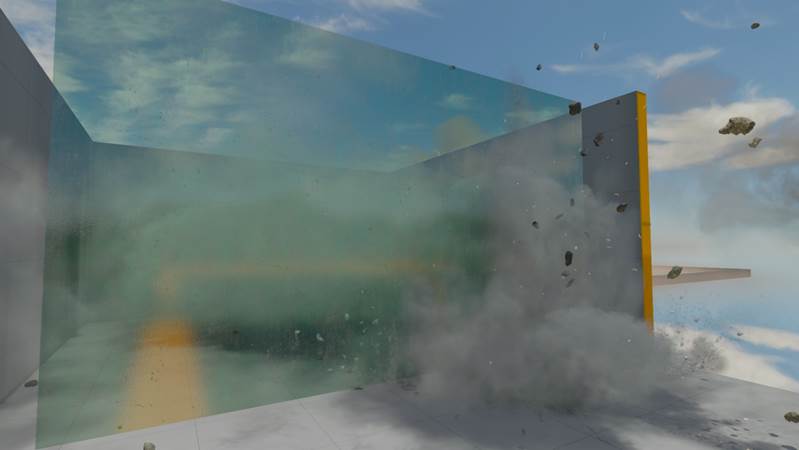
Abstract: Rendering transparent objects and effects
in real-time with high performance remains a significant challenge in game
development. This talk explores the journey of the Call of Duty
rendering engine as it transitioned to order-independent transparency (OIT)
while supporting active game releases.
Several established algorithms for
rendering transparency offer varying trade-offs in accuracy, robustness, and
performance. However, none fully met the unique
requirements of the Call of Duty franchise’s unique requirements, where
visual accuracy is critical for gameplay and performance is paramount. This
insight led to the development of a novel OIT technique: Adaptive
Voxel-Based Order-Independent Transparency (AVBOIT).
This presentation covers the principles
behind AVBOIT, its implementation details, and its performance profile across
various hardware platforms. It also evaluates the advantages and limitations of
this novel method, providing a balanced perspective on its practical impact.
The talk includes a comparative analysis with industry-standard transparency
algorithms and discusses practical applications using existing game content,
highlighting game-specific challenges and solutions. Finally, it addresses ongoing
work and potential future extensions for the method.
Speaker Bio:
 Michal Drobot, a Technical Fellow
at Activision, serves as the Franchise Rendering Director for the Call of
Duty series.
Michal Drobot, a Technical Fellow
at Activision, serves as the Franchise Rendering Director for the Call of
Duty series.
Over the past
decade, Michal has driven rendering architecture for seven Call of Duty titles,
collaborating with Activision studios to bring their creative visions to life.
Previously, he contributed to the design and optimization of the 3D renderer
for Far Cry 4 at Ubisoft Montreal. Prior to that, he worked at Guerrilla
Games, where he designed and optimized the rendering pipeline for the
PlayStation 4 launch title Killzone: Shadow Fall.
Michal specializes
in rendering algorithms, rendering architectures, hardware optimization, and
low-level performance enhancements.
Materials (Updated 9/29/2025):
PDF (6 MB)
RAY TRACING THE WORLD OF ASSASSIN'S
CREED SHADOWS
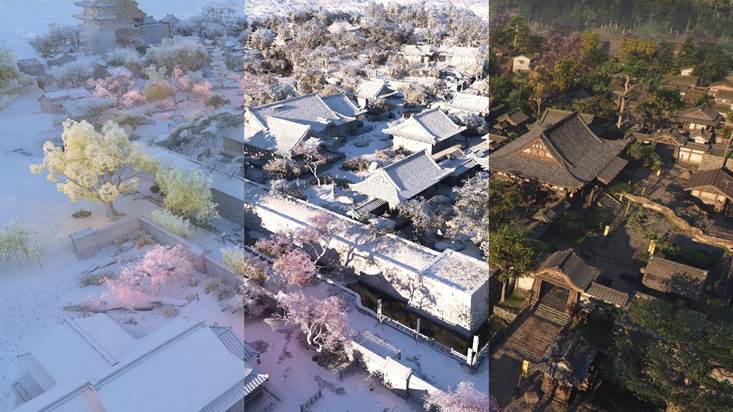
Abstract: Assassin’s Creed Shadows was
developed with the Anvil game engine and is set in feudal Japan. For this game,
we developed a ray-traced global illumination solution supporting large-scale
dynamic open-worlds and their specificities. We will present the algorithms we
rely on, the choices made for the foundation of our ray tracing pipeline, the
reasoning behind them and their detailed performance. The talk will also cover
the many challenges we faced due to the accurate depiction of this historical period
such as translucent geometries, thin walls, small windows and large quantities
of dense vegetation. We will also give insight into the challenges of
implementing specular reflection inside our global illumination solution in the
short period given by the delayed launch.
Speakers Bio:
|
|
Luc Leblanc is a Technical Lead for Anvil’s rendering team specializing in ray
tracing and lighting topics. He has a research background from his PhD in
addition to 25 years of experience in the rendering field and over 12 years
of experience in the video-game industry. Notably, he was the main
contributor for global illumination and ray tracing development at Eidos
Montreal and for ray-traced specular global illumination on Assassin's
Creed Shadows at Ubisoft Montreal. |
|
|
Melino Conte is Team Lead and contributor for
Anvil’s rendering team specializing in ray tracing and lighting topics. He
has 10 years’ experience in the rendering field and 7 years of experience in
the video game industry. Melino previously worked on rendering for Marvel's
Guardians of the Galaxy title at Eidos Montreal and contributed on the
ray tracing topics for Assassin's Creed Shadows at Ubisoft Montreal. |


Materials (Updated
8/26/2025): PDF
(14 MB)
STRAND-BASED HAIR AND FUR RENDERING IN INDIANA
JONES AND THE GREAT CIRCLE
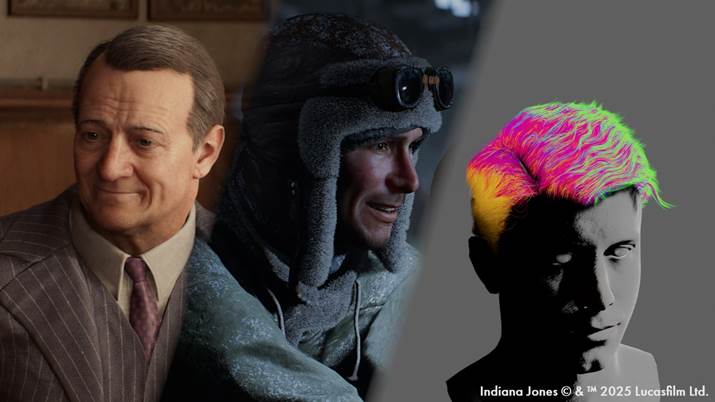
Abstract: Strand hair systems are quickly becoming
more widely adopted in video games. These systems offer very high levels of
visual fidelity and help artists reduce iteration time when creating hair
assets. However, performance constraints often considerably limit strand hair
usage, especially on lower-end hardware.
In this talk, we will present our take on
strand-based hair rendering with a focus on performance across a wide range of
hardware. We will cover design constraints and decisions, various GPU
optimizations for hair rasterization and shading, and problems we had to solve
on our road to ship "Indiana Jones and the Great Circle" as a
60 Hz game, using strands as the only solution for human hair rendering.
Speakers Bio:
|
|
Sergei Kulikov is a senior
render programmer at MachineGames, where he has
worked on Indiana Jones and the Great Circle for the last 2.5 years.
His current focus area is character rendering and lighting technology. Earlier he worked as a graphics programmer
at My.Games on War
Robots: Frontiers and Armored Warfare. Before joining game
development, he spent several years at Siemens working on CAD systems |

Materials (Updated
11/11/2025): PPTX
(114 MB), PDF
(3 MB)
FAST AS HELL: IDTECH8 GLOBAL ILLUMINATION
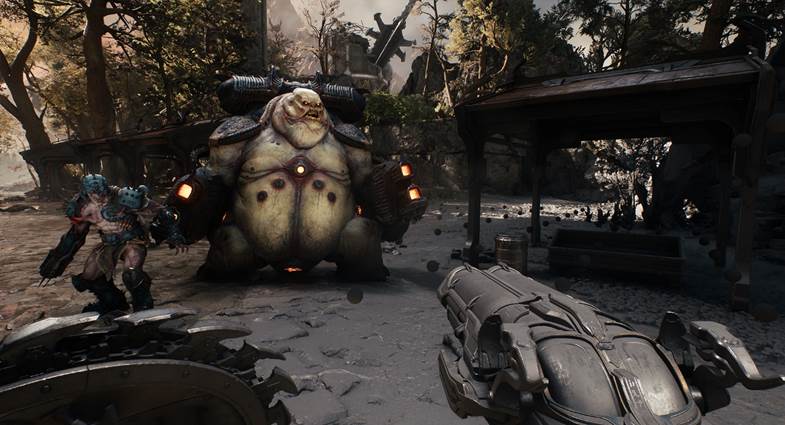
Abstract: Learn about idTech
8 and how id Software transitioned from a pre-baked global illumination to a
"fast as hell" real-time solution, enabling DOOM The Dark Ages
to achieve 60hz or higher on all platforms.
Speakers Bio:
|
|
Tiago Sousa is id
Software’s Rendering Technical Director, where most recently contributed to
the id Tech 8 game engine and the critically acclaimed DOOM The Dark Ages.
With over 20 years of experience in the
video game industry, Tiago is passionate about computer graphics technology
and has worked on notable titles, including Far Cry, the Crysis
trilogy, DOOM (2016), DOOM Eternal, Wolfenstein II: The New
Colossus, and others. |

Materials (Updated
8/25/2025): PPTX (96 MB), PDF (3 MB)
STOCHASTIC TILE-BASED LIGHTING IN HYPEHYPE
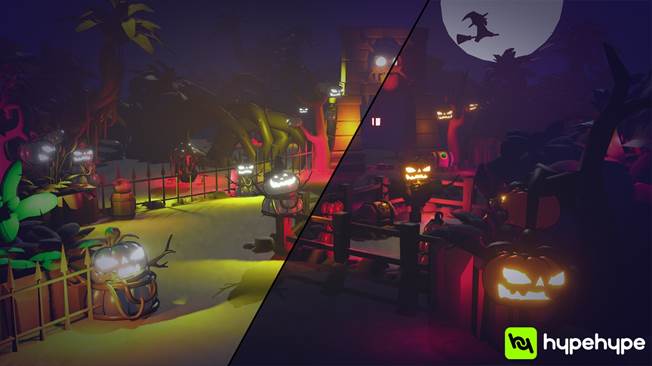
Abstract: HypeHype
is a gaming platform supporting user-generated content across a wide range of
devices, from low-end mobile phones to high-end PCs. To give creators complete
freedom in lighting their scenes, our lighting solution must deliver consistent
results with high performance across all the target platforms. In this talk, we
present a novel stochastic tile-based lighting algorithm that enables fully
dynamic, fixed-cost local lighting with shadows—even on low-end mobile GPUs.
The algorithm is optimized for GPU wave
coherence and efficient memory bandwidth usage, and it uses a two-stage light
sampling strategy:
- Big-Tile Sampling: The screen is divided into large tiles, and a
subset of lights is selected per tile using Stratified Reservoir Sampling
(SRS) guided by a coarse PDF.
- Small-Tile Resampling: We resample smaller tiles from the big-tile
reservoirs using a more refined PDF for high quality light samples.
By sharing light samples across small tile
pixels, the algorithm amortizes resampling costs and
improves GPU coherence, achieving efficient performance even on constrained
devices. We will discuss the design choices, implementation details, and
performance optimizations that make this approach scalable down to entry-level
mobile hardware.
Speakers Bio:
|
|
Jarkko Lempiäinen is a veteran
graphics programmer who has been professionally developing real-time
rendering technology for games and interactive applications since 1999.
Before joining HypeHype as Principal Graphics
Engineer to help shape its mobile platform, he contributed to numerous
large-scale AAA productions, working across multiple studios and game engines
in both lead and senior engineering roles. His passion for computer graphics began
well before his professional career. In the early 1980s, he started writing
small games on the ZX Spectrum 48 and continued experimenting with graphics
on 286-era PCs - long before the advent of GPUs. Starting from the early
’90s, he was active in the demoscene, sharpening
his skills in low-level optimization and visual effects. That deep-rooted
enthusiasm for pushing visual fidelity and technical limits continues to
inspire his work today. |

Materials (Updated
8/25/2025): PPTX (108 MB), PDF (3 MB)
REAL-TIME SUBSURFACE SCATTERING VIA HYBRID
RESTIR-PATH-TRACING AND DIFFUSION

Abstract: This presentation introduces a novel
hybrid solution for real-time subsurface scattering (SSS) that approaches
path-traced quality while maintaining interactive performance. Traditional
real-time SSS relies on diffusion approximations, but these methods often
produce artifacts when handling thin or curved regions, such as nostrils and
ears, due to their semi-infinite medium assumption. To address this limitation,
we combine a brute-force volumetric path tracing component for single
scattering with a newly derived, physically based diffusion profile for
multiple scattering. This hybrid approach accurately captures the subtle
transmission and scattering behaviors across a wide range of translucent
materials, improving visual fidelity and reducing unwanted artifacts.
Additionally, we demonstrate how ReSTIR can be
integrated into this workflow to accelerate path-traced single-scattering
computation. By leveraging ReSTIR’s reservoir-based
sampling, our method strategically reuses samples over space and time, reducing
noise and computational cost without sacrificing quality. As a result, users
can achieve the appearance of path tracing—even in challenging scenarios—at
frame rates suitable for real-time applications.
Attendees will learn practical strategies
for implementing this hybrid approach in their own rendering pipelines. We
emphasize how to balance physical rigor with efficient sampling and filtering,
ensuring consistent, near-ground-truth results for numerous types of assets and
lighting conditions. This talk empowers developers and technical artists to
adopt path-tracer-level SSS in real-time environments, marking a significant
step toward more lifelike digital humans, film-quality virtual production, and other
use cases demanding high-fidelity translucency at interactive speeds.
Speakers Bio:
|
|
Tianyi
"Tanki" Zhang is a senior real-time rendering engineer at NVIDIA, working on the
Omniverse RTX Renderer. As a rendering engineer, his focus includes real-time
path tracing light transport algorithms and systems, path tracing real-time
neural graphics primitive (Gaussian, NeRF),
ultra-realistic XR pipeline integrating path tracing and compositing.
Previously, Tanki was a Rendering Engineer Intern at Epic Games, contributing
to real-time ray tracing features for Unreal Engine. With a background in
computer science, game development, and art design, he is passionate about
pushing the boundaries of computer graphics and shaping its future. |

Materials (Updated
8/25/2025): PPTX
(395 MB), PDF
(6.3 MB)
MEGALIGHTS: STOCHASTIC DIRECT LIGHTING IN UNREAL
ENGINE 5

Abstract: MegaLights, Unreal
Engine 5’s new stochastic direct lighting path, enables artists to place
orders of magnitude more dynamic and shadowed area lights than they could ever
before. It’s designed to support current generation consoles and leverages ray
tracing to enable realistic soft shadows from various types of area lights.
We surveyed existing explicit light
sampling techniques such as light hierarchies or reservoir resampling-based
approaches and found them difficult to scale to current generation consoles.
Our talk will discuss how we overcome these challenges.
We will explain all parts of a complete direct lighting solution: how we sample
lights, guide rays, our ray tracing pipeline, handle ray tracing geometry
mismatches, scalability, translucency, volumetric effects, sample shading and
denoising, while still being able to fit in the target hardware constraints.
Speakers Bio:
|
|
Krzysztof
Narkowicz is an
Engineering Fellow in Graphics at Epic Games, where he co-founded Lumen and
works on lighting. Prior to that, he spent over a decade working on smaller
game titles at 11 Bit Studios and Flying Wild Hog. He loves working with
artists, pretty pixels and coding “close to the metal”. |
|
|
Tiago Costa is a Principal
Rendering Programmer at Epic Games, working on ray tracing and other
rendering features. Previously he worked at Rockstar North, Apple and Meta
Reality Labs. |


Materials (Updated
8/25/2025): PDF
(14 MB)
Direct contact:
