


Course Description
Advances in
real-time graphics research and the increasing power of mainstream GPUs has generated
an explosion of innovative algorithms suitable for rendering complex virtual
worlds at interactive rates. This course will focus on the interchange of ideas
from game development and graphics research, demonstrating converging
algorithms enabling unprecedented visual quality in real-time. This course will
focus on recent innovations in real-time rendering algorithms used in shipping
commercial games and high-end graphics demos. Many of these techniques are
derived from academic work which has been presented at SIGGRAPH in the past and
we seek to give back to the SIGGRAPH community by sharing what we have learned
while deploying advanced real-time rendering techniques into the mainstream
marketplace.
This course was introduced to SIGGRAPH community last year and it was
extremely well received. Our lecturers have presented several innovative
rendering techniques – and you will be able to find many of those techniques
shine in the upcoming state-of-the-art games shipping this year and even see
the previews of those games in this year’s Electronic Theater. This year we
will bring an entirely new set of techniques to the table, and even more of
them are coming directly from the game development community, along with
industry and academia presenters.
The second-year version of this course will include state-of[1]the-art
real-time rendering research as well as algorithms implemented in several award[1]winning
games and will focus on general, optimized methods applicable in variety of
applications including scientific visualization, offline and cinematic
rendering, and game rendering. Some of the topics covered will include
rendering face wrinkles in real-time; surface detail maps with soft
self-shadowing and fast vector texture maps rendering in Valve’s SourceTM engine; interactive illustrative
rendering in Valve’s Team Fortress 2. This course will cover terrain rendering
and shader network design in the latest Frostbite rendering engine from DICE,
and the architectural design and framework for direct and indirect illumination
from the upcoming CryEngine 2.0 by Crytek. We will also introduce the idea of
using GPU for direct computation of non-rigid body deformations at interactive
rates, along with advanced particle dynamics using DirectX10 API.
We will provide an updated version of these course notes with more
materials about real-time tessellation and noise computation on GPU in
real-time, downloadable from ACM Digital Library and from AMD ATI developer
website prior to SIGGRAPH.
Previous years’ Advances course slides: go here
Syllabus
Welcome and Introduction to Advances in Real-Time Rendering
in 3D Graphics and Games
Natalya
Tatarchuk (AMD)
Real-Time Particle System on the GPU in Dynamic
Environments
Shanon Drone (Microsoft)
Dynamic Deformation Textures
Nico Galoppo (UNC)
Surface Detail Maps with Soft Self-Shadowing
Chris Green (Valve)
Simple, Fast Vector Texture Maps on GPU
Chris Green (Valve)
Real-Time Tessellation on GPU
Natalya
Tatarchuk (AMD)
Tessellation in Viva Piñata
Michael
Boulton, Rare
Illustrative Rendering in Team Fortress 2
Jason L. Mitchell (Valve)
Frostbite Rendering Architecture and Case Study: Terrain
Rendering
Johan
Andersson (DICE)
Real-Time Wrinkles
Chris Oat (AMD)
Finding Next Gen - CryEngine2
Martin
Mittring (Crytek)
Closing Remarks
Natalya
Tatarchuk (AMD)
Prerequisites
This course is intended for graphics researchers,
game developers and technical directors. Thorough knowledge of 3D image
synthesis, computer graphics illumination models, the DirectX and OpenGL API
Interface and high-level shading languages and C/C++ programming are assumed.
Intended Audience
Technical
practitioners and developers of graphics engines for visualization, games, or
effects rendering who are interested in interactive rendering.
Course Organizer
Natalya Tatarchuk is a staff research engineer leading the
research team in AMD's 3D Application Research Group, where pushes the GPU
boundaries investigating innovative graphics techniques and creating striking
interactive renderings leading the research team. In the past she led the
creation of the state-of-the-art realistic rendering of city environments in
ATI demo “ToyShop” and has been the lead for the
tools group at ATI Research. Natalya has been in the graphics industry for
years, having previously worked on haptic 3D modeling software, scientific
visualization libraries, among others. She has published multiple papers in
various computer graphics conferences and articles in technical book series
such as ShaderX and Game Programming Gems and has
presented talks at SIGGRAPH and at Game Developers Conferences worldwide,
amongst others. Natalya holds BAs in Computers Science and Mathematics from
Boston University.
Talks
Real-Time Particle Systems on the GPU in
Dynamic Environments
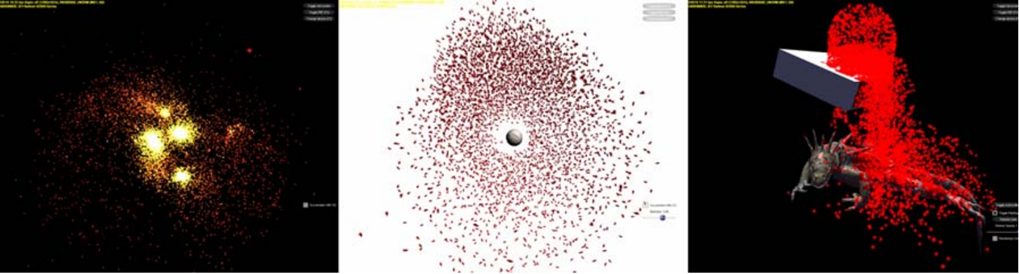
Abstract:
This
presentation details methods for simulating advanced particle systems entirely
on the GPU, enabling complex interactions between particles and their
environments in real time. The approach leverages non-parametric particle
systems, which integrate acceleration and velocity over time to allow for
dynamic, responsive behavior beyond the constraints of analytical motion paths.
Key techniques include GPU-based storage and double buffering of particle
states, N-body interactions using force splatting, flocking behaviors with
collision avoidance and alignment via mip-map
averaging, and environmental reactivity through both spherical and
arbitrary-object collision handling using volume textures. The talk also
explores bidirectional interactions, where particles influence scene
appearance, such as painting effects, while maintaining high performance. By
exploiting modern GPU features such as geometry shaders, texture arrays, and
instancing, this work demonstrates how particle systems can achieve high
fidelity, scalability, and responsiveness for games, simulations, and
interactive applications.
Speaker Bio:
Shanon Drone is a software
developer at Microsoft. Shanon joined Microsoft in
2001 and has recently been working on Direct3D 10 samples and applications. He
spends a great deal of his time researching and implementing new and novel
graphics techniques.
Materials: PowerPoint
Slides (5.6 MB), PDF
Slides (3.3 MB), Course
Notes (1.9 MB)
https://doi.org/10.1145/1281500.1281670
Dynamic
Deformation Textures
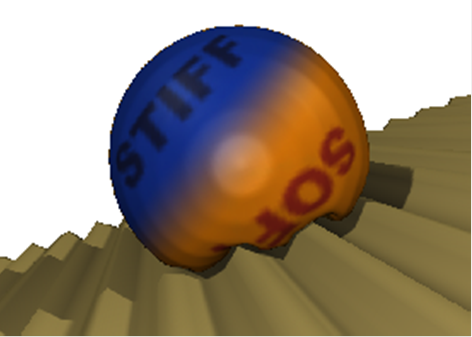
Abstract:
This
presentation introduces a GPU-accelerated framework for simulating deformable
models in real time through the use of dynamic deformation textures. The method
focuses on efficiently modeling complex surface deformations resulting from
contact, such as dents, footprints, and other localized changes, without
requiring high-resolution mesh modifications. By encoding deformation data into
textures and leveraging parallel GPU processing, the approach achieves high
visual detail with minimal computational overhead, making it well suited for
interactive applications such as games and simulations. The talk covers the
underlying physical modeling, data representation strategies, and rendering
techniques, along with examples demonstrating integration into existing
graphics pipelines. This technique enables realistic, responsive deformations
that can be applied to a variety of materials and geometries, maintaining both
performance and visual fidelity across diverse hardware platforms.
Speaker Bio:
Nico Galoppo is currently a PhD.
student in the GAMMA research group at the UNC Computer Science Department,
where his research is mainly related to physically based animation and
simulation of rigid, quasi-rigid and deformable objects, adaptive dynamics of
articulated bodies, hair rendering, and many other computer graphics related
topics. He also has experience with accelerated numerical algorithms on
graphics processors, such as matrix decomposition. His advisor is Prof. Ming C.
Lin and he is also in close collaboration with Dr. Miguel A. Otaduy v (ETHZ). Nico has published several peer-reviewed
papers in various ACM conference proceedings had he has presented his work at
the SIGGRAPH and ACM Symposium of Computer Animation conferences. Nico grew up
in Belgium and holds an MSc in Electrical Engineering from the Katholieke Universiteit Leuven.
Materials: Course
Notes (0.98 MB)
https://doi.org/10.1145/1281500.1281669
Surface Detail Maps with Soft
Self-Shadowing

Abstract:
This presentation introduces an enhanced radiosity normal mapping
technique that integrates directional self-shadowing into bump-mapped surfaces
without increasing texture memory usage or reducing performance. By pre-baking
the lighting basis directly into bump map data, the method allows both static
radiosity and dynamic light sources to benefit from soft, directionally
accurate occlusion. The approach encodes directional ambient occlusion directly
into the RGB channels of the normal map, enabling realistic shading effects
such as bent normals and diffuse self-shadowing while
improving anti-aliasing, filtering, and numeric precision. The system is
compatible with existing art pipelines, works on older hardware, and can
generate maps from procedural, modeled, or captured height data. Used extensively
in titles such as Half-Life 2: Episode 2 and Team Fortress 2,
this technique provides a practical, artist-friendly solution for achieving
high-quality surface detail and lighting realism in real-time rendering.
Speaker Bio:
Chris Green is a software engineer at Valve and has
been working on the Half-Life 2 series and Day of Defeat. Prior
to joining Valve, Chris Green worked on such projects as Flight Simulator II,
Ultima Underworld, the Amiga OS, and Magic: The Gathering Online.
He ran his own development studio, Leaping Lizard Software, for 9 years.
Materials: PDF
Slides (0.5MB), Course
Notes (0.15 MB)
Simple, Fast Vector Texture Maps on GPU
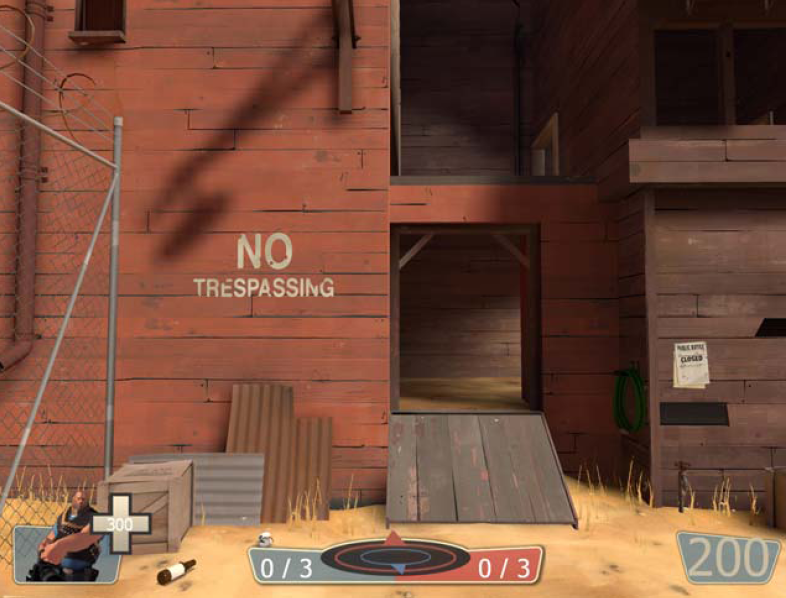
Abstract: A simple and
efficient method is presented which allows improved rendering of glyphs
composed of curved and linear elements. A distance field is generated from a
high-resolution image and then stored into a channel of a lower-resolution
texture. In the simplest case, this texture can then be rendered simply by
using the alpha-testing and alpha-thresholding feature of modern GPUs, without
a custom shader. This allows the technique to be used on even the lowest-end 3D
graphics hardware.
With the use of programmable shading, the technique is extended to
perform various special effect renderings, including soft edges, outlining,
drop shadows, multi-colored images, and sharp corners.
Speaker Bio:
Chris Green is a software engineer at Valve and has
been working on the Half-Life 2 series and Day of Defeat. Prior
to joining Valve, Chris Green worked on such projects as Flight Simulator II,
Ultima Underworld, the Amiga OS, and Magic: The Gathering Online.
He ran his own development studio, Leaping Lizard Software, for 9 years.
Materials: PowerPoint
Slides (5.3 MB), PDF
Slides (0.9MB), Course
Notes (0.25 MB)
https://doi.org/10.1145/1281500.1281665
Real-Time
Tessellation on GPU
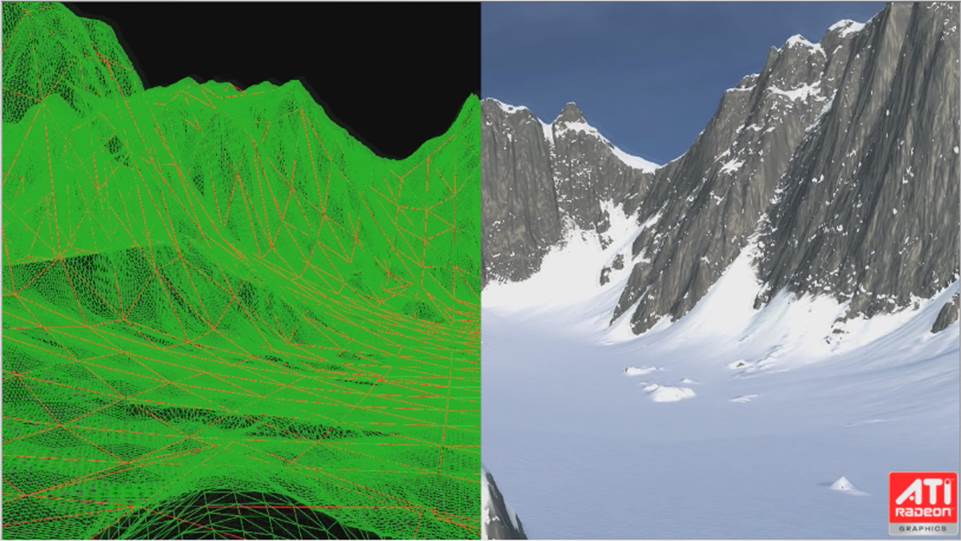
Abstract:
This presentation
explores the use of hardware tessellation to achieve high-detail, film-quality
character rendering in real time. It describes a pipeline in which coarse
artist-created control meshes are dynamically subdivided on the GPU, enabling
adaptive triangle density based on camera distance and screen-space error
metrics. The approach supports displacement mapping, detailed surface shading,
and seamless integration of complex normal and bump maps, while maintaining
consistent performance across varying levels of detail. Key topics include
tessellation algorithms, displacement mapping workflows, efficient GPU data
management, and rendering optimizations for dynamic characters. By leveraging
dedicated tessellation hardware, this technique bridges the gap between
offline-quality models and interactive performance, allowing for richly
detailed and responsive characters in modern game engines.
Speaker Bio:
Natalya Tatarchuk is a staff research engineer leading the
research team in AMD's 3D Application Research Group, where pushes the GPU
boundaries investigating innovative graphics techniques and creating striking
interactive renderings leading the research team. In the past she led the
creation of the state-of-the-art realistic rendering of city environments in
ATI demo “ToyShop” and has been the lead for the
tools group at ATI Research. Natalya has been in the graphics industry for
years, having previously worked on haptic 3D modeling software, scientific
visualization libraries, among others. She has published multiple papers in
various computer graphics conferences and articles in technical book series
such as ShaderX and Game Programming Gems and has
presented talks at SIGGRAPH and at Game Developers Conferences worldwide,
amongst others. Natalya holds BAs in Computers Science and Mathematics from
Boston University.
Materials: PowerPoint Slides (20 MB),
PDF Slides (14.8 MB)
https://doi.org/10.1145/1281500.1361219
Tessellation
in Viva Piñata
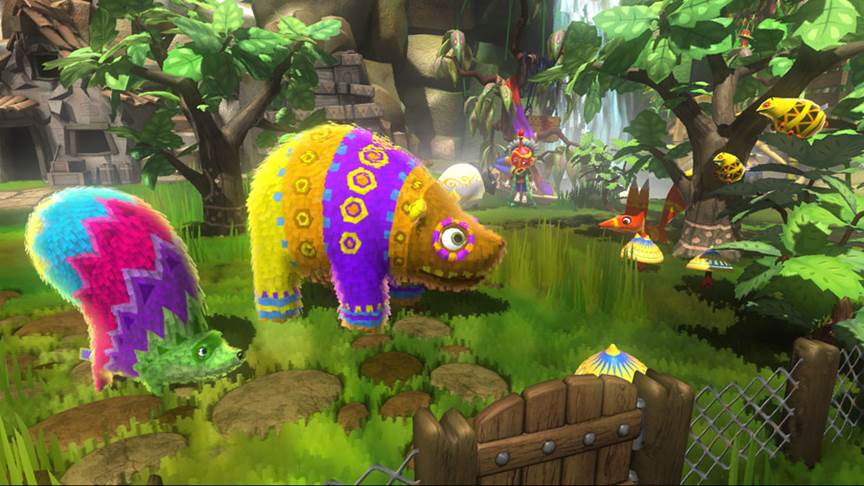
Abstract:
This
presentation describes the tessellation techniques developed for Viva Piñata
on the Xbox 360 to manage the game’s high scene complexity and demanding GPU
workloads. Despite its stylized look, the title features unified shadowing,
volumetric rendering, and expensive shaders, making efficient level-of-detail
management essential. The talk focuses on edge-based tessellation of the game’s
central “diggable surface,” dynamically adjusting tessellation factors based on
screen-space edge length to preserve visual quality near the player while
rapidly reducing detail with distance. The method also incorporates
optimizations such as disabling tessellation for off-screen tiles, handling
attribute interpolation issues with auxiliary textures, and using vertex shader
filtering to avoid artifacts at terrain-water transitions. By combining visual
fidelity with performance-conscious design, the approach ensures consistent
frame rates while maintaining the game’s rich and interactive environments.
Speaker Bio:
Michael (“Mike”) Boulton is a graphics engineer who worked at
Rare/Microsoft Game Studios and later at 343 Industries. He presented
“Tessellation in Viva Piñata” at the SIGGRAPH 2007 “Advanced Real-Time
Rendering in 3D Graphics and Games” course while a Senior Software Engineer at
Rare/MGS.
His shipped credits include Viva Piñata (2006), Banjo-Kazooie: Nuts
& Bolts (2008), Halo: Reach (2010), Halo 4 (2012), and Halo 5 projects,
culminating in Graphics Engineering leadership roles at 343 Industries.
Materials: PowerPoint Slides (4 MB),
PDF Slides (0.8 MB), video (25 MB)
https://doi.org/10.1145/1281500.1361219
Illustrative Rendering in Team Fortress
2
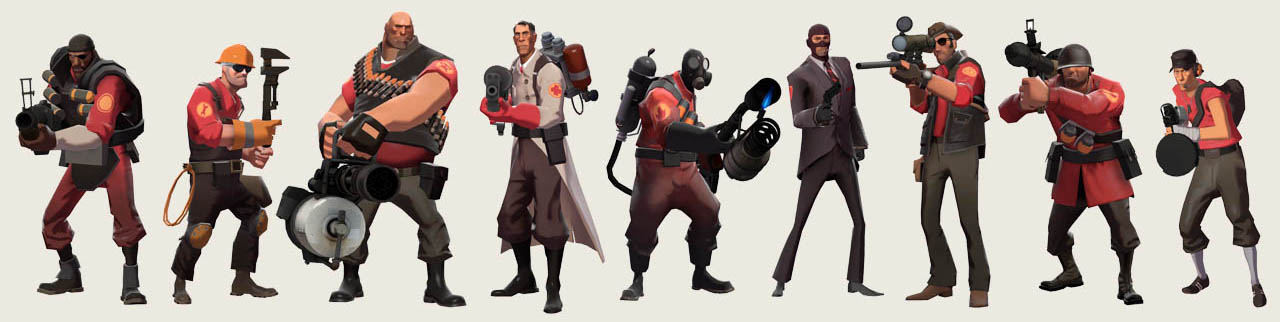
Abstract: We present a set of artistic choices and
novel real-time shading techniques which support each other to enable the
unique rendering style of the game Team Fortress 2. Grounded in the
conventions of early 20th century commercial illustration, the look of Team
Fortress 2 is the result of tight collaboration between artists and
engineers. In this paper, we will discuss the way in which art direction and
technology choices combine to support artistic goals and gameplay constraints.
In addition to achieving a compelling style, the shading techniques are
designed to quickly convey geometric information using rim highlights as well
as variation in luminance and hue, so that game players are consistently able
to visually "read" the scene and identify other players in a variety
of lighting conditions.
Speaker Bio:
Jason L. Mitchell is a software developer at Valve, where
he works on real-time graphics techniques for all of Valve's projects. Prior to
joining Valve in 2005, Jason worked at ATI for 8 years, where he led the 3D
Application Research Group. He received a BS in Computer Engineering from Case
Western Reserve University and an MS in Electrical Engineering from the
University of Cincinnati.
Materials: PowerPoint
Slides (10.2 MB), PDF Slides (2.8 MB),
Course
Notes (0.4 MB)
https://doi.org/10.1145/1274871.1274883
Frostbite Rendering Architecture and Case Study:
Terrain Rendering
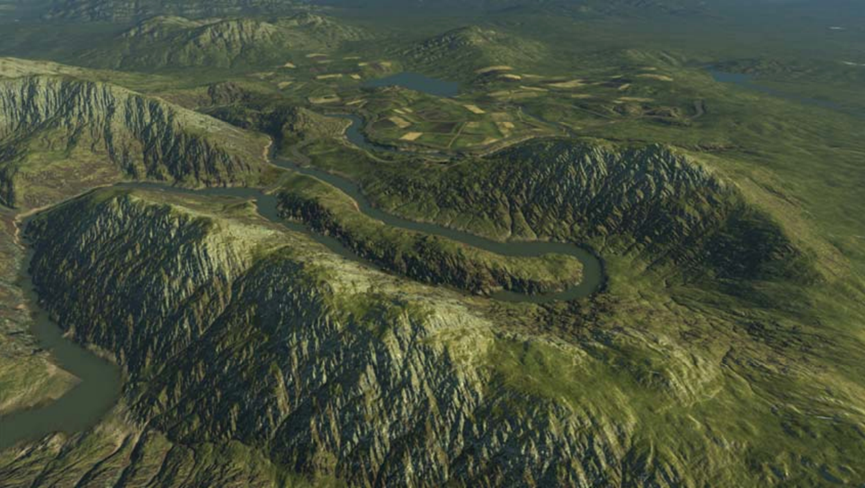
Abstract:
This
presentation explores modern techniques for efficient, high-quality terrain
rendering, focusing on scalability from small-scale environments to expansive,
real-time landscapes. It examines the core challenges of rendering large
terrains - such as memory management, level-of-detail (LOD) transitions,
geometric complexity, and texturing - while maintaining interactive frame
rates. The talk presents a structured pipeline that integrates GPU-friendly
data structures, chunked LOD meshes, and view-dependent refinement strategies
to optimize both performance and visual fidelity. Special attention is given to
handling vast heightfield data sets, procedural detail generation, and
minimizing popping artifacts through geomorphing and
texture blending. By combining algorithmic optimizations with
hardware-conscious design, the approach enables robust terrain rendering
suitable for simulations, games, and virtual environments, delivering
consistent results across varied hardware platforms.
Speaker Bio:
Johan Andersson is a self-taught senior software
engineer/architect in the central technology group at DICE. For the past 7
years he has been working on the rendering and core engine systems for games in
the RalliSport and Battlefield series. He now drives the
rendering side of the new Frostbite engine for the pilot game Battlefield:
Bad Company (Xbox 360, PS3). Recent contributions include a talk at GDC
about graph-based procedural shading.
Materials: PowerPoint Slides (18.2 MB),
PDF Slides (8.4 MB), Course Notes (1.6
MB)
https://doi.org/10.1145/1281500.128166
Animated Wrinkle Maps
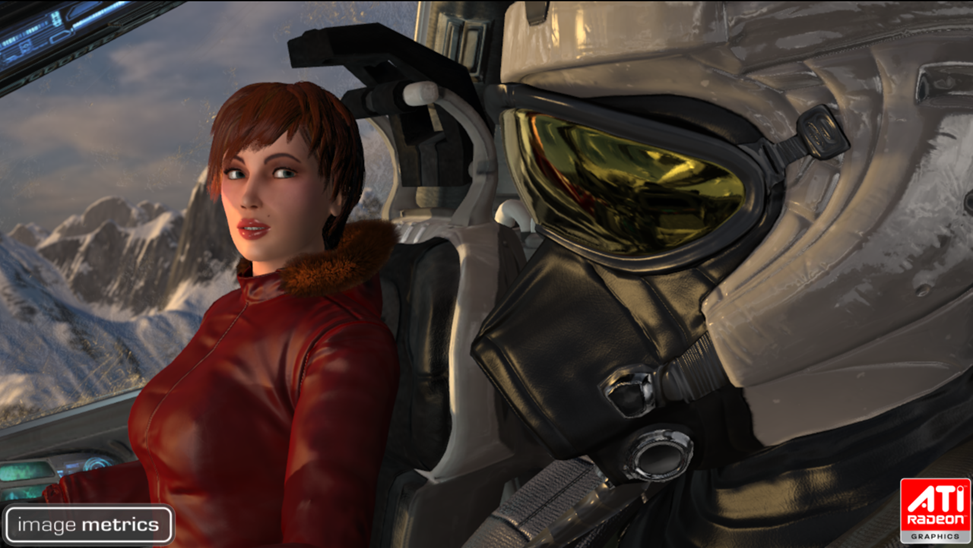
Abstract: An efficient method for rendering animated
wrinkles on a human face is presented. This method allows an animator to
independently blend multiple wrinkle maps across multiple regions of a textured
mesh such as the female character shown in above. This method is efficient in
terms of computation as well as storage costs and is easily implemented in a
real-time application using modern programmable graphics processors.
Speaker Bio:
Chris Oat is a staff engineer in AMD's 3D Application
Research Group where he is the technical lead for the group's demo team. In
this role, he focuses on the development of cutting-edge rendering techniques
for leading edge graphics platforms. Christopher has published several articles
in the ShaderX and Game Programming Gems series and
has presented his work at graphics and game developer conferences around the
world.
Materials: PowerPoint
Slides (13 MB), PDF Slides (2.8 MB),
Course
Notes (0.15 MB)
https://doi.org/10.1145/1281500.128166
Finding
Next Gen - CryEngine2
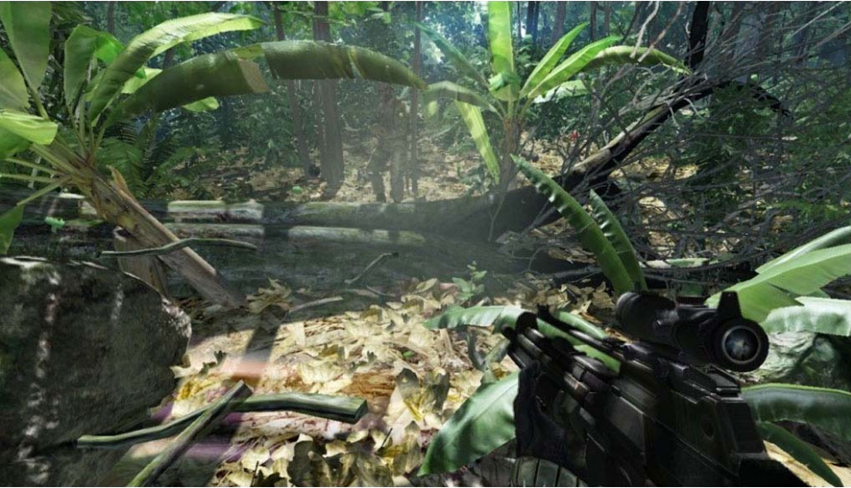
Abstract:
This presentation
examines the architectural and rendering innovations behind CryEngine 2,
designed to deliver next-generation real-time graphics for large-scale
interactive worlds. It covers the engine's unified rendering pipeline, dynamic
lighting and shadowing systems, and advanced material framework that supports
complex shader combinations. The talk highlights techniques for high-fidelity
vegetation rendering, seamless indoor-outdoor transitions, and efficient
streaming of massive environments. Special emphasis is placed on deferred
lighting, parallax occlusion mapping, volumetric effects, and procedural
systems that enhance realism while maintaining performance. By integrating
scalability across hardware tiers with artist-friendly workflows, CryEngine
2 demonstrates how cutting-edge rendering features can be balanced with the
practical demands of production, enabling richly detailed and immersive virtual
environments.
Speaker Bio:
Martin Mittring is a software
engineer and member of the R&D staff at Crytek. Martin started his first
experiments early with text-based computers, which led to a passion for
computers and graphics in particular. He studied computer science and worked in
one other German games company before he joined Crytek. During the development
of Far Cry he was working on improving the PolybumpTM
tools and became lead network programmer for that game. His passion for
graphics brought him back to former path and so he became lead graphics
programmer in R&D. Currently he is busy working on the next iteration of
the engine to keep pushing future PC and next-gen console technology.
Materials: PowerPoint Slides
(13 MB), PDF
Slides (2.3 MB), Course
Notes (1.5 MB)
Direct contact:
